Agentlytics by Advancelytics LogoAgentlytics
☰

Agentlytics β€” Journey Decision Intelligence for B2B SaaS Websites

Journey decision intelligence for B2B SaaS

Your analytics sees the visit. Can it see the decision forming β€” and act on it?

Interested visitors are evaluating your website right now. Most analytics tells you what they did after the fact. Agentlytics helps you understand what they may be trying to decide β€” and lets your team engage while the journey is still happening.

01
Journey tracked
02
Decision layer applied
03
Action prepared
Free plan availableNo CRM replacementNo workflow disruptionSetup in minutes
Journey intelligence system
Session in progress
Exploration
26
Evaluation
14
Validation
8
Decision
7
Conversion
3
Decision layer reading
Readiness and hesitation mapped
74% intervention confidence
Signal progression
Live
1
Source
Acquisition path captured
Live
2
Journey
Pages and sections connected
3 visits
3
Decision layer
Hesitation and readiness scored
74%
4
Human handoff
Journey context ready
Take over
Decision brief
Journey
Source -> page -> section -> revisit
Hesitation
Pricing and rollout friction
Readiness
High, but needs clarity
Next move
Offer migration and rollout context
Suggested opening

You've been reviewing the enterprise tier. Most teams at your stage want clarity on migration and rollout. Happy to walk through that.

Human handoff
Ready to take over
Visits
3 visits
Revisit
Pricing revisited twice
Likely blocker
Migration / rollout clarity
Journey context
Source β†’ Product β†’ Integrations β†’ Pricing
View full journey
Journey Decision Intelligence

Understand the Decision Behind the Entire Visitor Journey

A conversion decision rarely happens on one page.

Agentlytics connects the visitor journey across acquisition source, page movement, section engagement, dwell, interactions, revisits, and decision friction β€” then interprets what those observed patterns may indicate about evaluation, readiness, and the appropriate next action.

Agentlytics interprets observed behavior. It does not claim certainty about private buyer intent.

What is Journey Decision Intelligence?

Journey Decision Intelligence is the journey-analysis layer within the Unified Decision Intelligence Frameworkβ„’. It connects a visitor's observed website behavior with decision signals such as evaluation, hesitation, readiness, friction, supporting evidence, and the next useful action.

Part of the Unified Decision Intelligence Frameworkβ„’

The framework turns observed behavior into structured decision context β€” connecting journey evidence to interpretation, readiness, friction, and the next useful action.

Journey pipeline

Evidence becomes interpretation.

01

Source

02

Page Journey

03

Section Engagement

04

Dwell & Interaction Signals

05

Revisit & Friction Patterns

06

Decision State

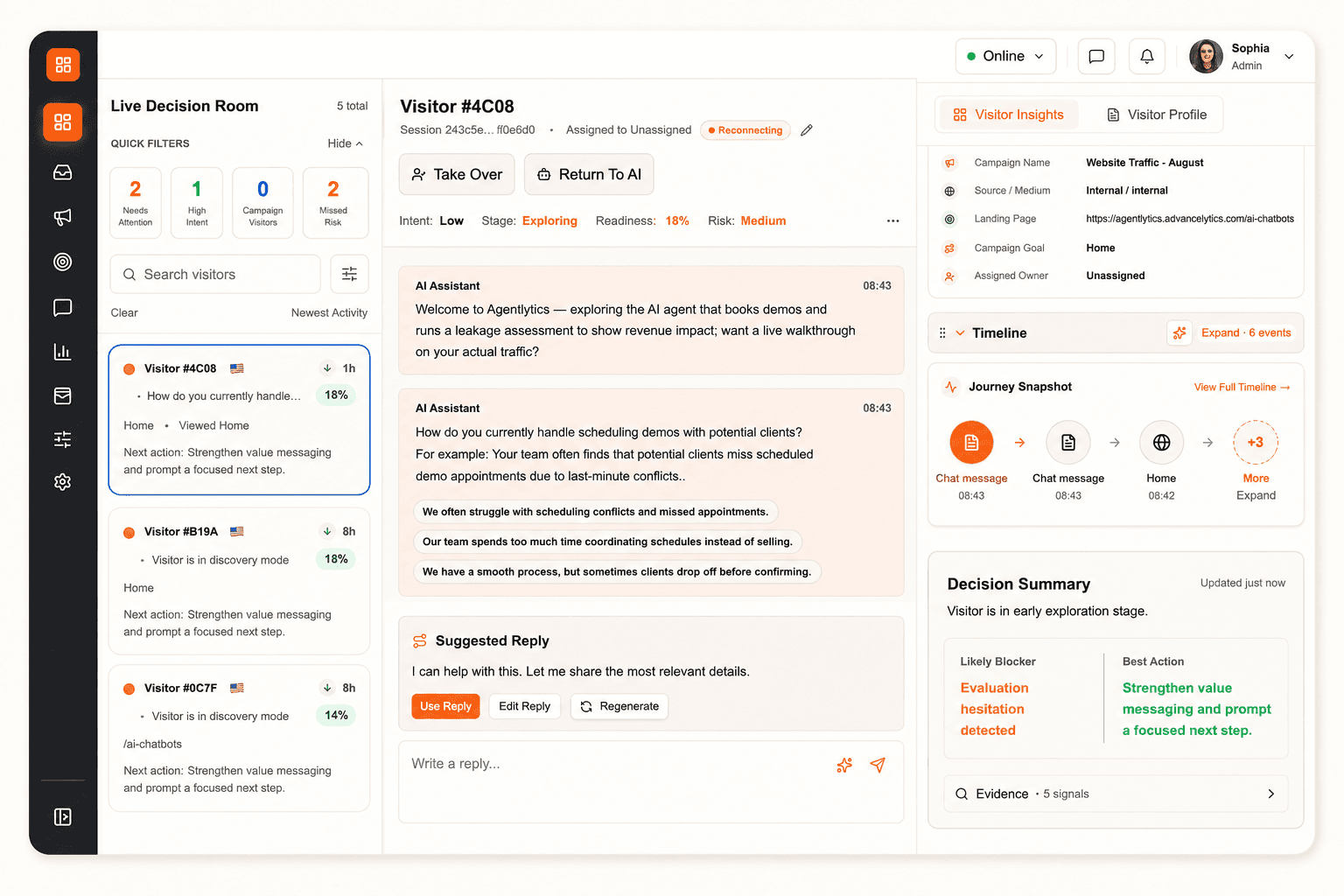
Live Decision Room

Visitor journey, conversation, and decision signals in one operator view.

Live Decision Room product interface showing visitor list, conversation context, and decision intelligence

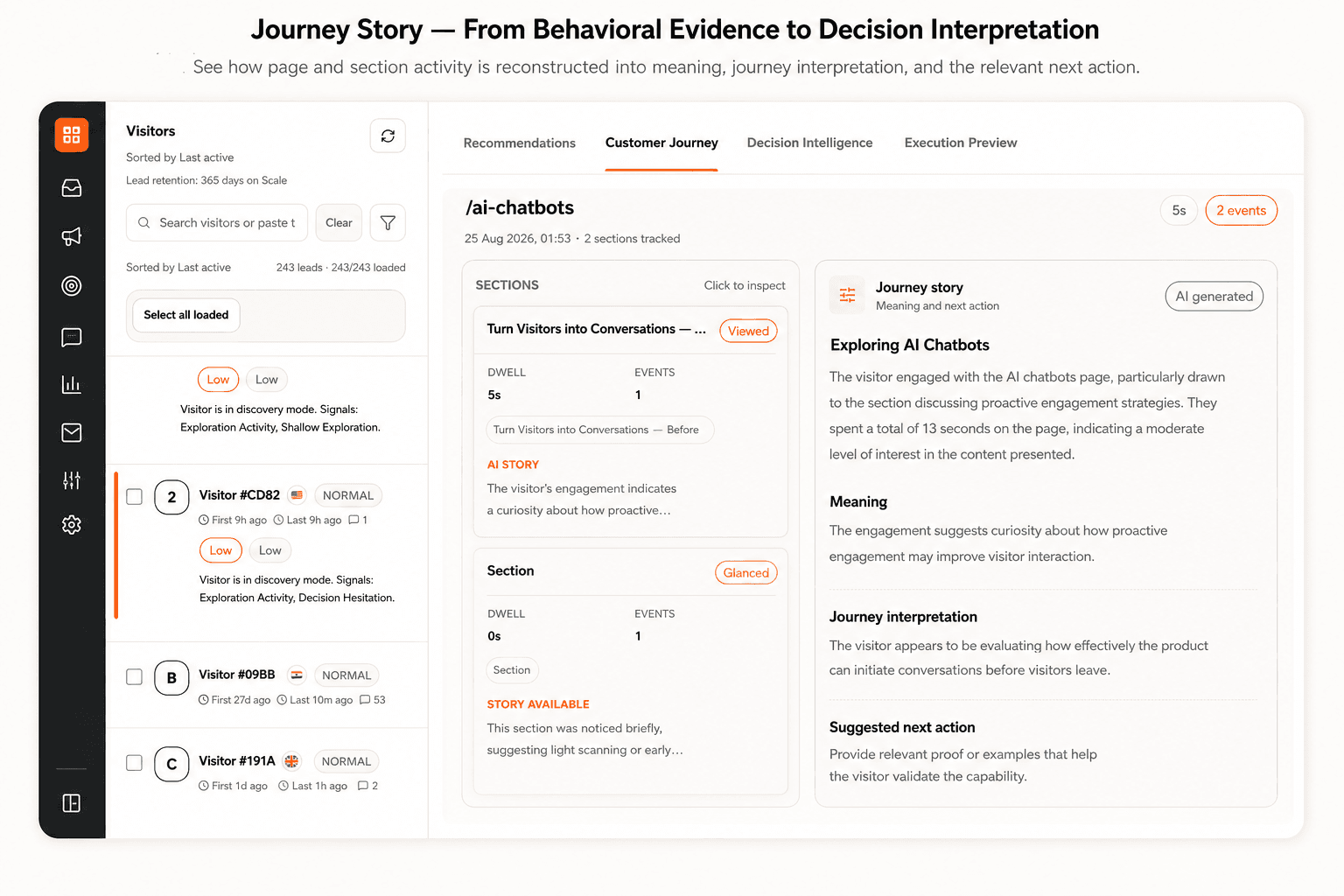
Journey Story

See the Story Behind the Decision

Instead of treating page views as isolated events, Agentlytics connects the story: where the visitor came from, what they examined, where attention held, where momentum changed, and what action your team should consider next.

What the visitor appears to be evaluating.
Which pages and sections receive sustained attention.
Where dwell and interaction patterns change.
Whether the visitor returns to previously evaluated content.
Where friction or hesitation signals emerge.
How those signals map to readiness and a relevant next action.
Journey Story product interface showing behavioral evidence reconstructed into decision meaning

From Journey Tracking to Decision Interpretation

Traditional journey analytics can show where a visitor came from, which pages they viewed, what they clicked, and where the journey ended.

Journey Decision Intelligence adds an interpretation layer across those events.

Consider a hypothetical journey: a visitor arrives from ChatGPT, explores a product page, spends time on a specific section, returns on later visits, revisits pricing, pauses around a CTA, and continues evaluating.

Individually, these are behavioral events. Together, they create a decision pattern the platform interprets.

Agentlytics connects that journey into a structured view of evaluation context, decision stage, readiness, friction, supporting evidence, and the relevant next action.

Instead of asking only: β€œWhat did this visitor do?” teams can examine: β€œWhat might this complete journey indicate about the decision they are trying to make?”

See the Decision Behind Your Visitor Journeys
01Visitor

Selected visitor and exploration context.

02Behavioral evidence

Page, section, dwell and event activity.

03Journey interpretation

Behavioral evidence reconstructed into meaning.

04Next action

A relevant action suggested from the interpreted journey.

Founder note

Why we built Agentlytics

The problem came from watching real buyer behavior disappear between analytics, CRM, and sales follow-up.

"

We built Agentlytics after watching high-intent traffic disappear from our own B2B products with no signal from our CRM or analytics stack.

Visitors were spending minutes on pricing, returning multiple times, checking integrations β€” and then vanishing.

Our tools told us they'd been there. They couldn't tell us why they left. That gap is what Agentlytics is built to close.

Founding Team, Agentlytics

The real problem

Revenue does not break at the form. It breaks in the silence before it.

Traffic is not the problem. You already have buyers evaluating, comparing, returning, and reading proof. The real issue is that decision breakdown remains invisible until after confidence has already weakened.

By the time a form is submitted or abandoned, the buyer has often already moved through a hidden decision cycle. Conventional analytics, CRMs, and chat tools usually operate after the moment of failure. Agentlytics operates inside it.

That is the category difference: this is not conversation software. It is a decision-visibility layer for revenue stability.

A buyer visits your pricing page four times over five days, compares plans, revisits the enterprise tier, and disappears. Your CRM shows zero activity. Your team has no idea they were ever there.

What Agentlytics surfaces: price-sensitive evaluation, high hesitation density, pricing friction, exit risk, supporting evidence, and a recommended next action.
What Agentlytics sees

Traditional analytics measures activity. Agentlytics interprets it.

Pageviews tell you someone was there. They don't tell you what they were trying to figure out. Most analytics platforms stop at reporting β€” they show what happened across pages, clicks, and sessions. Agentlytics connects those events into the visitor's journey and interprets what the combined pattern may indicate, while the visitor is still evaluating.

Traditional analytics Β· records activity

Events stay separate.

Pageview→Click→Session→Exit

You can see what happened, but the evaluation context remains fragmented.

Agentlytics Β· connects + interprets

The journey becomes the signal.

Source→Page→Section→Dwell→Revisit→Journey Signal→Next Action

The sequence is connected into a live evaluation pattern that can inform the next action.

Real visitor journey

One journey. Two different views.

Representative example

Product

Viewed

Integrations

Evaluated

Product

Returned

Pricing

Viewed

Still exploring

Session active

Traditional analytics records

4 page interactions.

The activity is visible, but the evaluation pattern remains split across individual events.

Agentlytics connects

A continuing evaluation journey.

A visitor moving between product depth and pricing β€” a pattern that may indicate active evaluation, comparison, or unresolved confidence before the next step.

The difference is not another pageview. It is the context created when the sequence is connected and interpreted while the visitor is still evaluating.

Agentlytics interprets observed behavior, not private intent. A pricing revisit does not prove buying intent; it becomes more useful when interpreted alongside the rest of the visitor journey.

Home

18s

Pricing

1m 40s

Integrations

45s

Demo

56s

Journey note

Pricing and integration checks suggest setup-fit evaluation.

01

Full website journey

See the complete story behind every visit

Track every page visited, every section read, every button clicked, and every moment where interest builds or drops. Instead of traffic numbers, you get the actual journey β€” what the visitor explored, what they ignored, and where they slowed down before leaving.

Learn more β†’

Pricing page

Live
Starter
Growth
Scale

Triggered by hesitation

Need help choosing the right plan for your rollout?

02

Proactive AI engagement

Engage interested visitors before they disappear

That Product β†’ Integrations β†’ Product β†’ Pricing journey matters most while the visitor is still on your site. Agentlytics detects repeated evaluation, pricing revisits, and changes in engagement as they happen. When those patterns may indicate unresolved friction, it can trigger contextual guidance before the visitor leaves β€” a relevant message, proactive conversation, or nudge toward the information they may be missing.

Learn more β†’
JS

Visitor chat

Context preserved

Does this work with HubSpot?
Yes. You were checking integrations, so here is the setup path and demo option.
Pricing viewed
Integrations read
Demo intent
03

Reactive AI chat

Answer questions the moment they are asked

Visitors can ask about pricing, features, integrations, or process and get instant answers. Every conversation is logged with context β€” so your team sees not just what was asked, but what the visitor had already explored before they typed anything.

Learn more β†’

Agentlytics works alongside your existing CRM, chat, and sales motion. Nothing replaced. Everything made more visible.

See it on your traffic β†’
Decision stage detected
Hesitation pattern flagged
Exit risk: high
Price-sensitive evaluator
Conversion probability 70%
Agent briefed in real time
Decision stage detected
Hesitation pattern flagged
Exit risk: high
Price-sensitive evaluator
Conversion probability 70%
Agent briefed in real time
The mechanism

Behavior is decision evidence. The system reads it continuously.

The mechanism is not a stack of disconnected features. It is a continuous decision system that converts raw behavior into classification, hesitation detection, and precise action.

01
What visitors do before they decide

Navigation depth, pricing dwell, comparison activity, revisit patterns, and session progression are treated as decision evidence instead of passive analytics.

02
Where each visitor is in their decision right now

Every session is classified into a live decision state: exploring, evaluating, hesitating, or decision-ready. The state updates as buyer behavior evolves.

03
When a buyer stalls without saying why

When evaluation continues without confidence building, the system identifies a hesitation pattern and generates a structured decision brief.

04
Precise intervention

The right content, routed alert, or human response is triggered with decision context before the buyer exits or the handoff resets the interaction.

Live buyer session
Decision motion across multiple visits
Example timeline
Day 1 Β· 09:14
First visit

Pricing page explored. Enterprise tier reviewed. Session classified: Exploring.

Day 3 Β· 14:33
Return visit

Comparison content viewed. Pricing revisited. State shifts to: Evaluating.

Day 5 Β· 11:02
Hesitation flagged

Third pricing revisit. 4m 12s dwell. No commitment. Decision brief generated.

Day 5 Β· 11:08
Agent briefed

Agent receives full context and starts mid-decision β€” not from a blank slate.

How it works

From your site URL to live decision intelligence in minutes.

No sitemap required. No manual knowledge base. Paste your URL and Agentlytics maps the site, lets you shape how engagement should work by page and section, tracks the visitor journey, interprets the signals, and helps your team act while the visitor is still there.

01

URL

Map + design

02

Track

Observe journey

03

Interpret

Connect signals

04

Act

Engage or handoff

01

Add your URL & design the workflow

Paste your website URL. Agentlytics maps your pages and sections automatically β€” no sitemap or manual knowledge base required. Then shape how engagement should work on each page and section.

Websitehttps://yourcompany.com
Product→Integrations→Pricing→Demo

Design the engagement workflow

Question→Choices→Response→Follow-up→CTA→Next action

Define what the AI should ask, what visitors can choose, the response to each choice, follow-up questions, CTAs, and what happens next for each path.

02

Track the journey

Agentlytics follows observed behavior across source, pages, sections, dwell, interactions, questions, and revisits as the journey unfolds.

SourcePageSectionDwellInteractionRevisit

The system keeps the sequence connected instead of treating each event as an isolated pageview.

03

Interpret the signals

Those events are connected into a journey pattern that may indicate evaluation, hesitation, friction, or readiness β€” without claiming certainty about private intent.

Evaluation patternPossible hesitationReadiness signalLikely blocker

Interpretation comes from the combined journey, not one click or one page.

04

Act while it matters

Use that context to trigger relevant AI guidance, surface the next useful step, or hand the conversation to a human with the journey already attached.

Relevant messageProactive engagementCTA / next stepHuman handoff

The goal is not simply to record the journey. It is to make the journey useful while the visitor is still deciding.

URL→Track→Interpret→Act— one continuous path from setup to intervention.
Execution layer

When a human steps in, the journey comes with the visitor.

When a visitor is ready for a person, Agentlytics hands the conversation to your team with the journey attached β€” what they viewed, what they revisited, where hesitation appeared, and what that pattern may indicate.

Your rep doesn't start from zero. They enter the conversation with the visitor's evaluation context already available.

Context preserved across human handoff
Live agent console
Session: Active
Conversation
Hi β€” I was looking at your pricing. I'm not sure which plan fits our rollout.
You've been reviewing the enterprise tier. Most teams at your stage want clarity on migration and rollout. Happy to walk through that.
Yes β€” migration is exactly my concern.
Guidance panel
Likely blocker
Implementation confidence
Agent goal
Resolve rollout risk before discussing pricing tiers
Suggested direction: lead with migration path, then map plan fit.
Decision brief
Readiness state
Hesitating
Session count
3 sessions across 5 days
Hesitation type
Risk-oriented β€” pricing tier and implementation confidence
Key signals
4m 12s on pricing Β· comparison page visited twice Β· enterprise tier revisited
Risk level
Medium-high β€” active evaluation, confidence not yet established
Recommended open
"You have been reviewing the enterprise tier. Most teams at your stage want clarity on migration and rollout. Happy to walk through that."
Proof and Validation

Proof and Validation

Across our early deployment cohort, here's what we observed:

Journey evidence

Source, page, section, dwell, revisit, and conversation signals are kept together so teams can review the evidence behind each decision interpretation.

Interpretation limits

Agentlytics interprets observed behavior patterns. It does not claim certainty about private buyer intent or guarantee conversion outcomes.

Agent readiness

When a human joins, the decision brief explains what the visitor viewed, where hesitation appeared, and what action may be useful next.

Operational fit

The platform is designed to work alongside existing CRM, analytics, chat, and sales workflows instead of replacing the tools teams already use.

For your role

The same invisible problem looks different depending on where you sit.

CMO
"Where is high-intent traffic going after it leaves?"

See which behavioral patterns precede conversion, which ones signal silent abandonment, and where confidence breaks before the form ever appears.

Media spend accountability improves when you can see decision friction, not just top-line sessions.
CRO
"Why do deals go quiet in the final stretch when everything looked fine?"

Connect evaluation-stage hesitation to conversion instability before it becomes pipeline slippage. Exit risk, confidence trajectory, and primary blockers β€” visible before the deal dies.

Decision-stage visibility improves deal quality before the CRM ever records a late-stage problem.
Founder
"Who on my site is actually ready to talk β€” and who's just browsing?"

See every visitor's decision stage, intent score, lead quality, and primary blocker in real time. Know who to prioritise before they ask to speak to someone.

Your first sales conversations start informed, not from zero.
What gets measured

Decision instability is continuous. So is our detection of it.

5
Decision stages mapped continuously
Exploration Β· Evaluation Β· Validation Β· Decision Β· Conversion
Dozens
of behavior signals tracked per session
Pricing dwell Β· comparison loop Β· exit risk Β· hesitation pattern Β· buying intent
1
Decision leakage model per visitor
Flags stalled decision motion before visible drop-off occurs
0
Workflow resets required for deployment
No CRM replacement Β· no website rebuild Β· no sales-motion reset
AI agent

It doesn't wait for visitors to ask. It acts before they leave.

The Agentlytics AI agent runs end-to-end on your site β€” proactively engaging, qualifying, booking demos, answering queries, and handing off to humans with full decision context. No human in the loop until you're needed.

Proactive engagement

Engages based on scroll depth, dwell time, exit intent, and page type β€” intervening at the exact moment a visitor starts to disengage. Not just when they ask.

End-to-end lead capture

Captures contacts, qualifies intent, books demos, answers product queries, and handles objections β€” all within one conversation, without a human in the loop.

Auto-generated knowledge

Paste your URL. The system maps your site, generates page-specific Q&A, and trains the agent on your product. No manual setup. No knowledge base to build.

Multilingual + fully branded

Supports multiple languages. Fully customizable β€” colors, tone, avatar, and behavior β€” to match your brand exactly.

Integrations

Decision Context, Delivered Where Your Team Already Works

Your team already lives in HubSpot, Salesforce, Shopify, Slack, and Google Drive.

Agentlytics does not ask them to change that.

It carries buyer decision context into those systems when the signal matters β€” so the right person sees what changed, why it matters, and what should happen next.

HubSpot logo

HubSpot

For teams managing inbound leads in HubSpot.

Learn more

Before outreach starts, the rep sees the buyer's decision stage, primary blocker, risk level, and recommended next action β€” not just form data.

That context is already in the contact record, timeline, and sales task before the first message is sent.

Salesforce logo

Salesforce

For revenue teams managing pipeline, forecast, and enterprise deal movement in Salesforce.

Agentlytics surfaces which opportunities are gaining confidence, losing momentum, or carrying hidden stakeholder risk β€” directly in the records, tasks, and forecast views your team already uses.

RevOps gets signal. Reps get context. Forecast calls get fewer surprises.

Learn more
Shopify logo

Shopify

For commerce teams who need to know whether a shopper is browsing, stuck, or close to buying.

Agentlytics reads the full purchase journey β€” not just whether a cart was abandoned, but where confidence broke down before it did.

This helps teams distinguish casual browsing from active purchase intent β€” and identify whether the barrier is shipping concern, payment friction, or price sensitivity.

Learn more
Slack logo

Slack

For teams that need to act while the buyer is still live.

When a high-intent visitor returns, a known lead becomes at risk, or a decision-ready signal appears, the Slack alert carries journey context, primary blocker, and a suggested opening β€” not just a notification.

Learn more
Google Drive logo

Google Drive

For teams that want their knowledge base and buyer decision records connected in one workflow.

Agentlytics can connect Google Drive documents so approved content, product material, implementation notes, and internal knowledge can support buyer-facing intelligence.

It can also push Journey Intelligence Stories and Decision Intelligence Briefs into Drive, so lead context is stored, shared, and reviewed without rebuilding the record manually.

Learn more

The goal is not another connected tool.

The goal is preserved decision context across the systems your team already trusts.

vs alternatives

Not a chatbot. Not analytics. Not a CRM add-on.

Capability
Chatbots and live chat
Agentlytics
When it activates
After the buyer declares intent
Before the buyer knows what they want to ask
What it reads
Typed input and explicit questions
Behavior signals, hesitation patterns, and readiness shifts
Context on handoff
Agent starts cold
Agent receives a structured decision brief
What it resolves
Conversation handling
Why buyers go quiet before the form
Integration model
Often requires workflow adjustment
No CRM replacement or sales-motion rebuild
Revenue signal
Engagement activity
Decision-stage visibility and exit risk
See it in motion

A walkthrough of live decision signals, not a generic product demo.

Interactive walkthrough
Step 1 of 5 Β· Where revenue instability begins
Buyer journey
Exploring
Day 1 Β· 09:14
Landing page
Arrived from LinkedIn ad. Scrolled homepage for 42 seconds.
Day 1 Β· 09:15
Pricing page
Opened pricing. Spent 2m 10s reviewing enterprise tier.
β€”
Return visit
Not yet observed.
Behavior signals
Day 1 Β· 09:14
Pricing dwell2m 10s
Comparison activityNone
Return visits0
Hesitation scoreLow
Step 1 of 5 Β· Where revenue instability begins
The buyer arrives and spends over two minutes on the enterprise pricing tier β€” well above a casual glance. Conventional analytics records a pageview. Advancelytics records a decision signal. The classification begins: this session is exploring, not browsing.
Auto-advancing in 10s
Zero disruption

It works with what you already have. Not instead of it.

No CRM replacement or migration required
No change to your existing sales motion
No sitemap required β€” paste your site URL
No manual knowledge base to build
No new workflow your team has to learn first
HubSpot and Salesforce integrations in development
Honest questions

The questions a skeptic would ask.

Journey Decision Intelligence is Agentlytics' way of connecting a visitor's complete website journey with decision signals such as hesitation, readiness, friction, supporting evidence, and the next useful action for a revenue team.

Setup takes minutes. Paste your site URL β€” no sitemap required. The system crawls your site, maps pages and sections, then prepares visitor journey context, lead capture flows, qualification questions, and sales answers tailored to your product.

Agentlytics tracks observed website behavior such as traffic source, page visits, section engagement, dwell time, clicks, chat questions, answer choices, repeat visits, and handoff moments. It uses those signals to interpret hesitation, readiness, and friction without claiming certainty about private buyer intent.

No. Agentlytics is not a chatbot. Chatbots respond after a visitor types a question. Agentlytics interprets visitor behavior β€” clicks, pauses, pricing dwell, return visits β€” before a question is asked, and acts on decision signals while intent is still forming.

Heatmaps and session replay show what visitors did. Agentlytics interprets what those actions suggest about the visitor's decision state β€” hesitation, readiness, exit risk β€” and acts on that interpretation in real time, not in a post-session report.

Agentlytics uses observed signals such as acquisition source, page movement, section engagement, dwell time, repeat visits, pricing review, chat questions, answer choices, and handoff moments. These signals are interpreted as evidence, not as certainty about private intent.

Lead scoring assigns a static score based on firmographic or form data. Readiness mapping tracks live decision motion β€” where a visitor is in their evaluation right now, how their confidence is shifting, and whether hesitation is rising or resolving.

No. Agentlytics works alongside your existing CRM, chat, and sales motion. No CRM replacement, no workflow rebuild, no retraining required.

The agent receives a complete decision brief β€” what the visitor read, which pages they visited, how many times, how long they spent on pricing, what is likely blocking them, their hesitation type, risk level, and a recommended opening message.

Yes. The Agentlytics AI agent can capture contacts, qualify intent, book demos, answer product queries, and handle objections β€” all within one conversation, without a human in the loop.

No. Agentlytics interprets observed behavior signals; it does not claim certainty about private buyer intent or guarantee conversions. Its role is to make journey evidence, hesitation, readiness, friction, and recommended next actions visible earlier.

Ready when you are

See what Agentlytics finds on your website.

Start with your site URL. Agentlytics maps the journey, surfaces where evaluation may be slowing down, and shows the signals, friction, and next actions your team can actually use.